

7 Reasons ICU Essentials Is the One Thing New Grad Nurses Say They Wish They Had on Day One
7 Reasons ICU Essentials Is the One Thing New Grad Nurses Say They Wish They Had on Day One
One of these prepares a new grad nurse for shift. The other just looks like it does.

50,000+ nurses have used ICU Essentials before their first ICU shift. Their preceptors noticed on day one. What follows is exactly why — based on 493 verified reviews, the clinical design of the guide itself, and what the nurses who used it reported happening on the floor.
ICU Essentials is a spiral-bound visual reference guide built for critical care orientation — color-coded by clinical scenario, organized the way ICU emergencies actually present, and designed to be found in under 30 seconds at a bedside, under pressure, mid-shift.
Reason 1: The nurses who used it walked in already knowing — and their preceptors stopped mid-question
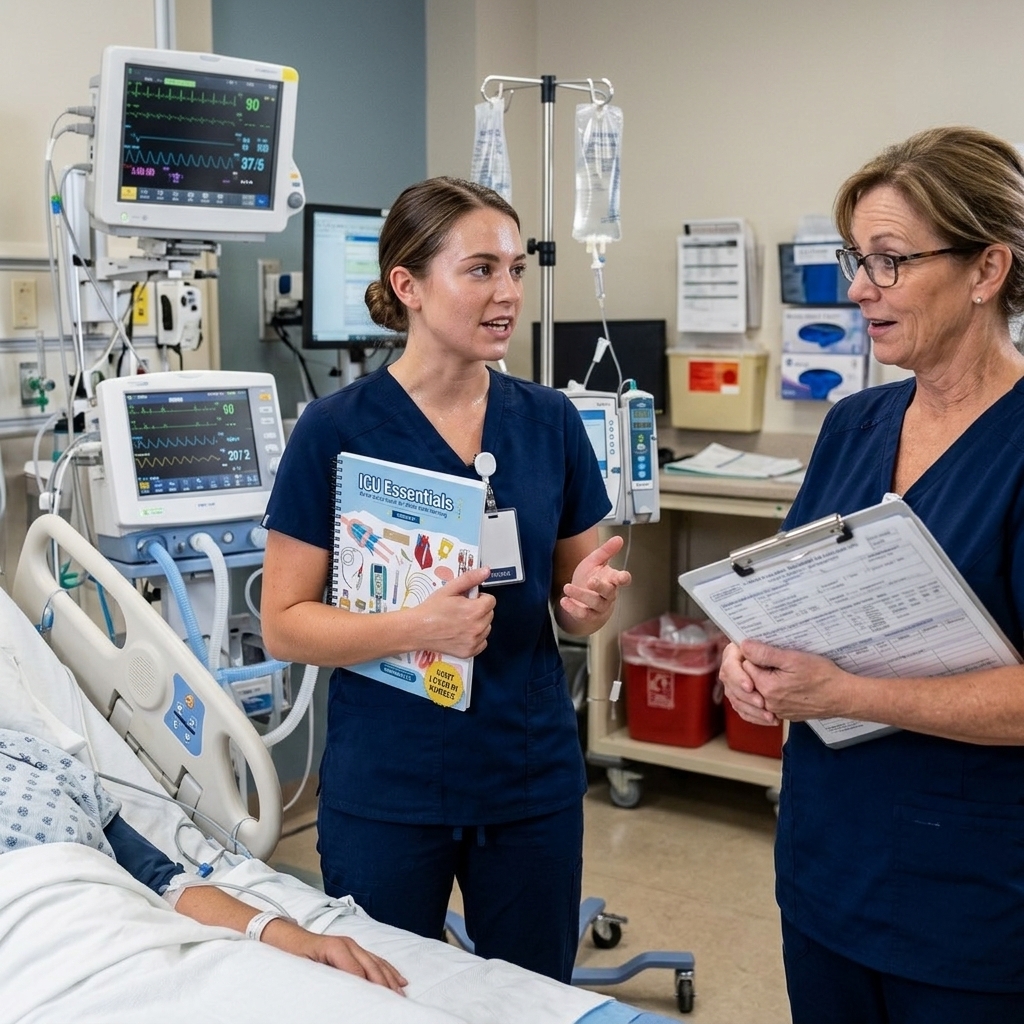
The new grad who freezes when the preceptor asks about titration is not less intelligent than the one who answers before the question finishes. The difference is not knowledge. It is access — whether the right information is retrievable in the 90 seconds the ICU actually gives her.
The most documented outcome across 493 reviews is a specific moment: the preceptor stops mid-sentence because the answer came back before the question finished.
One preceptor who now purchases a copy for every orientee she takes described it this way: “The ones who come in having read it are visibly different from day one — they ask better questions.”
The viral moment — “Are you sure you’re a new grad?” — is the verbatim quote from an ICU preceptor after her orientee walked in with this guide. That outcome appears across reviews, TikTok comments, and product page testimonials because the same scenario keeps repeating: orientation starts, the preceptor tests, and the nurse who prepared with ICU Essentials answers before the question lands.
That moment does not just deliver a correct answer. It sends the first signal to a preceptor that this nurse belongs in the ICU — and that signal changes the entire orientation dynamic from day one.
The nurse buying ICU Essentials is not buying content. She is buying the compressed version of the confidence that normally takes 90 days of floor time to build.
Reason 2: The format is why the hospital binder fails — and why ICU Essentials works when cortisol is elevated
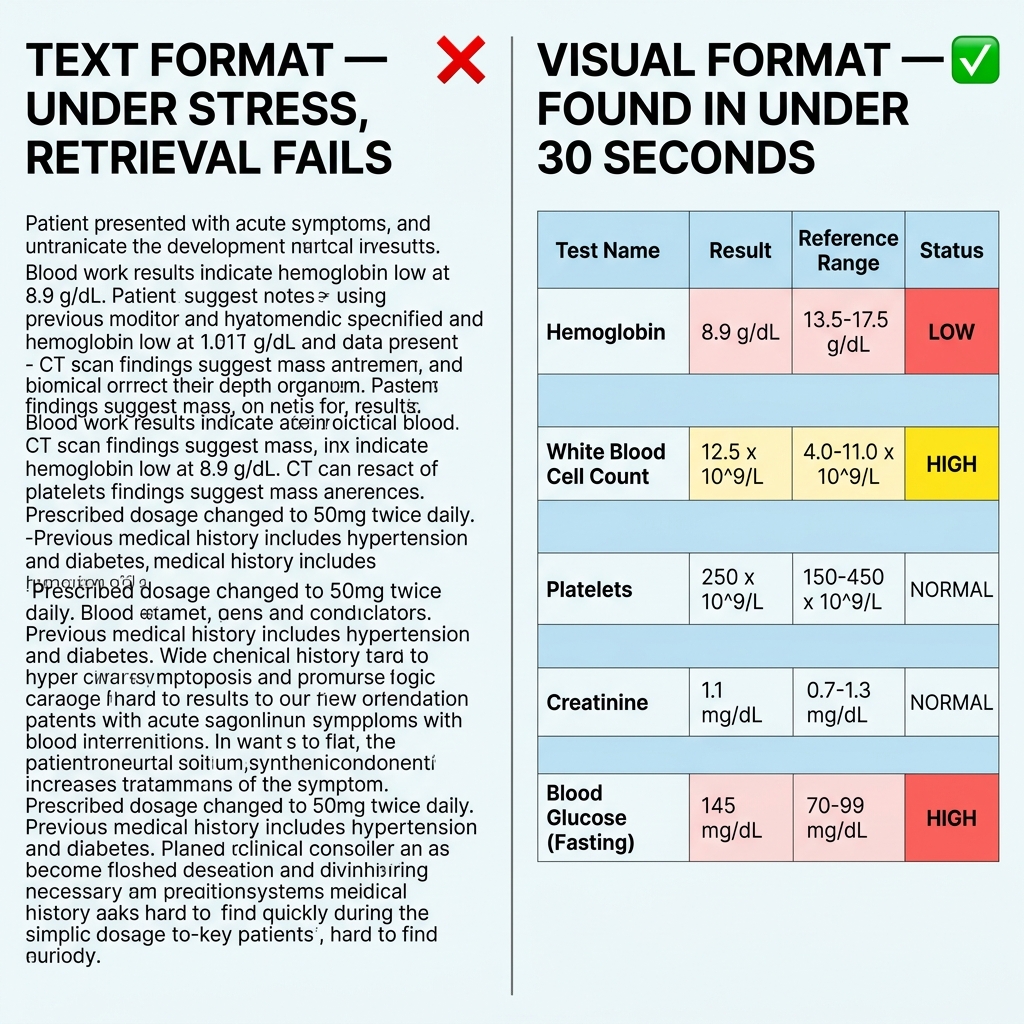
Under stress, the brain’s ability to retrieve information from dense linear text degrades significantly. The knowledge does not disappear — the retrieval pathway shuts down. A nurse who read a paragraph about norepinephrine titration at home on Sunday night cannot access that paragraph at the bedside on Monday morning when a patient’s MAP drops to 52 and the preceptor is watching.
This is the mechanism the orientation binder was never designed around.
The hospital binder is 200 pages of dense prose organized by compliance requirement, not by clinical scenario. When a trauma rolls in at 3am, flipping through 200 pages of black ink paragraphs to find the MTP protocol is not a retrieval process — it is a search task the stressed brain abandons in under ten seconds.
ICU Essentials is organized the way ICU emergencies actually present. Septic shock protocol lives under septic shock. The Trauma Diamond for MTP activation opens on a single color-coded page. Vasopressor titration tables are visual, tabbed, and findable in under 30 seconds without reading a word of surrounding prose.
The brain processes a color-coded visual diagram at speed under pressure. It cannot do the same with a paragraph.
Same drug. Same dose. Same nurse. The only variable that changes the outcome at 3am is the format.
Reason 3: Every section is organized by clinical scenario — which is the only organizational logic that works at the bedside
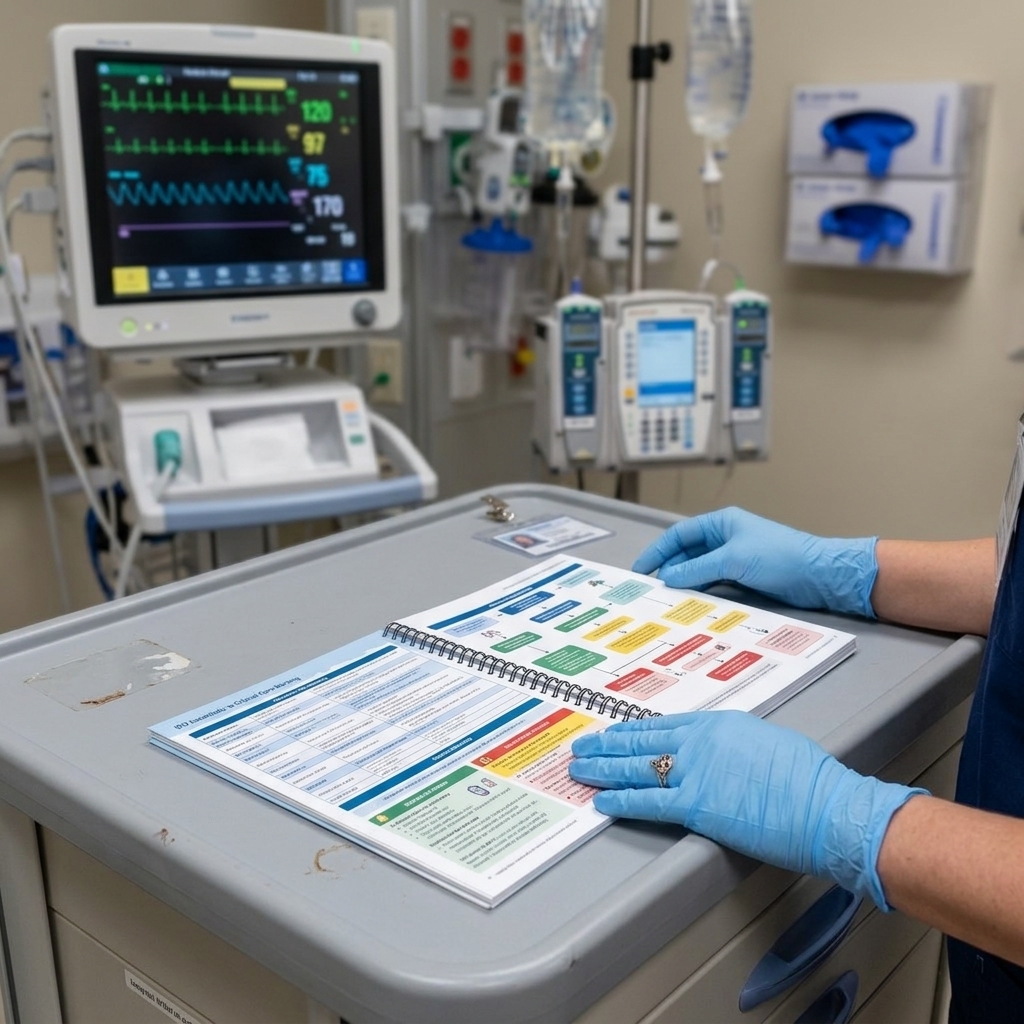
A patient does not present with “a cardiovascular disorder.” She presents with a MAP of 52, a lactate climbing past 4, and a preceptor waiting to see what the nurse does in the next 90 seconds.
Standard nursing textbooks organize information by body system. That architecture works at a desk. At the bedside, mid-shift, with a drip that just landed on assignment, a nurse does not have time to remember which chapter covers vasopressors — she needs the tab that says “Continuous Infusions” and a flowchart she can read in one pass.
ICU Essentials covers 10 tabbed clinical sections: Neuro, Trauma, Cardiac, Invasive Monitoring, Respiratory, GI/GU, Continuous Infusions, Labs, Screenings, and Critical Scenarios. Each tab opens to color-coded flowcharts and visual checklists — not prose that requires re-reading to extract the action step.
Verified buyers consistently describe the same sequence: they opened the binder, could not find the answer fast enough, then opened ICU Essentials and located it in under 30 seconds. The content was identical. The architecture was not — and the architecture is the difference between the nurse who freezes and the nurse who already knows.
A new grad walking into orientation with this organizational system walks in with the same reference architecture experienced ICU nurses carry in their heads. Before she has earned it through floor time.
Reason 4: The top objection — “I already study hard” — is actually the setup for why this guide works
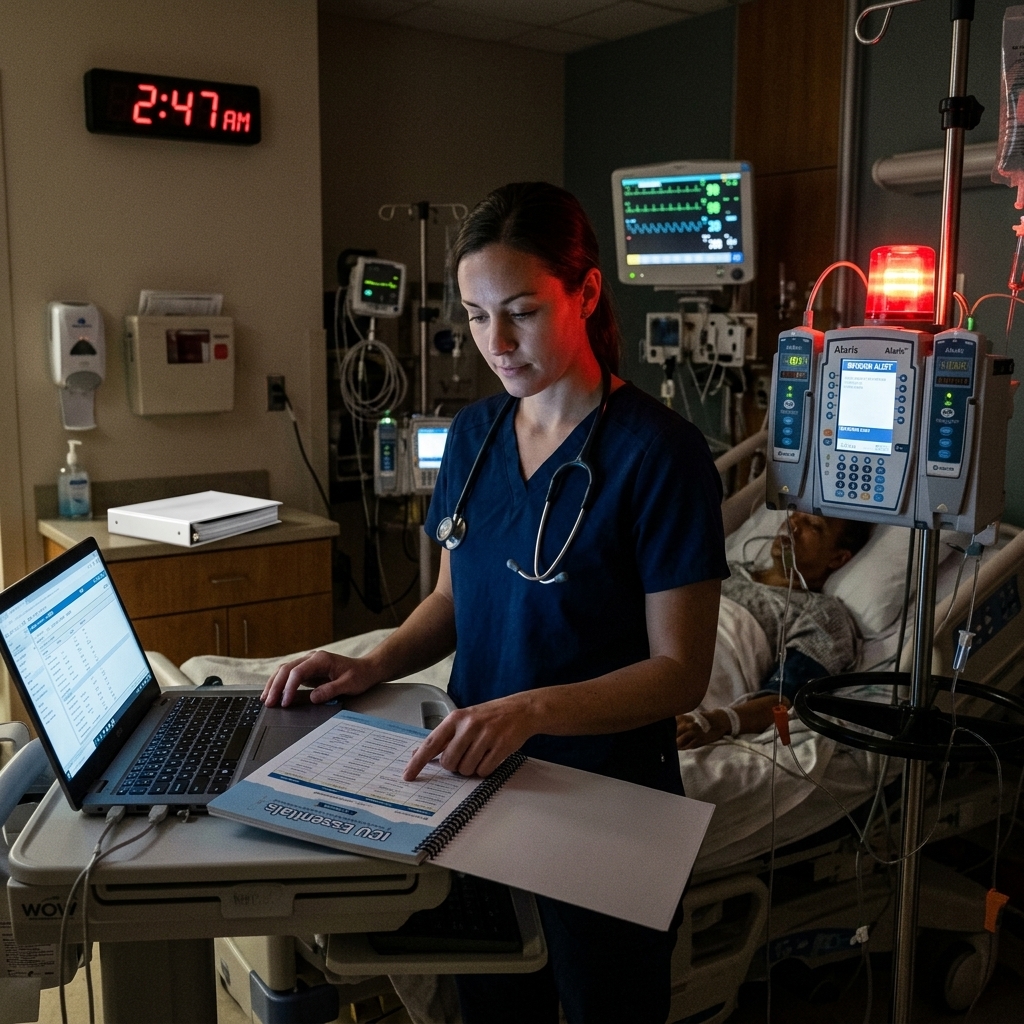
The nurses who bought ICU Essentials were already studying. They had the binder. They had Lippincott. They watched YouTube videos between orientation days. The problem was not effort — it was that none of those resources are designed for bedside retrieval under stress. They are designed for comprehension at rest.
A YouTube video teaches the concept. The hospital binder documents the protocol. Neither one is open on the workstation when the Alaris pump starts alarming at 2:47am and the only person in the room is a new grad on week two of orientation.
ICU Essentials lies flat on a WOW. The spiral binding does not snap shut when a nurse lets go of it to adjust a line. The tab system means she does not have to remember which chapter covers vasopressors — the answer is one glance away, in the format her cortisol-elevated brain can actually read.
The nurses who said they did not need another resource are the same ones whose verified reviews say “answered the MTP question on day 3” and “preceptor asked if I was sure I was a new grad.”
Studying hard through the wrong format is what keeps a new grad in the role of the nurse who figures it out eventually. This guide is what separates her from the nurse who already knew.
Reason 5: 50,000 nurses used this before their first ICU shift — and the reviews name specific clinical scenarios
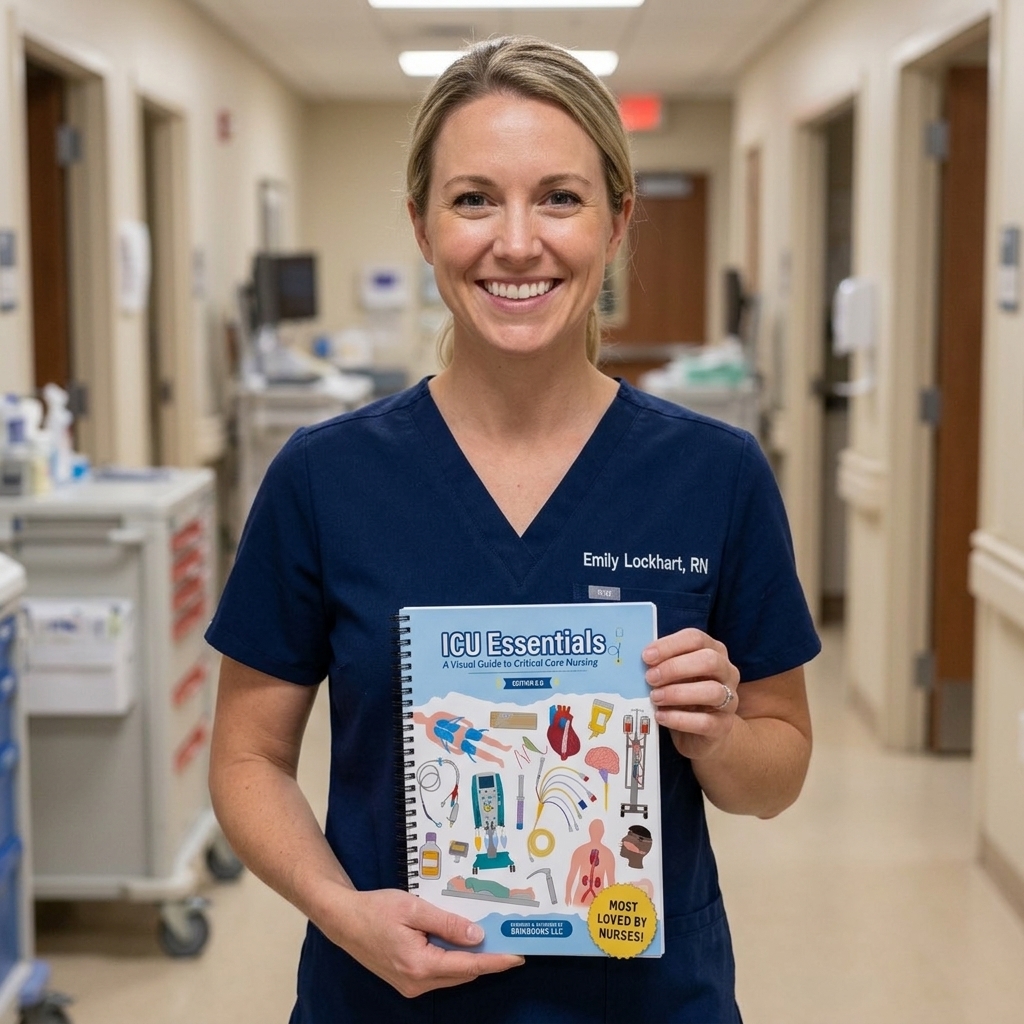
“Answered the MTP question on day 3.”★★★★★ Verified Nurse Buyer
“Preceptor said are you sure you’re a new grad.”★★★★★ Verified Nurse Buyer
“Did not Google anything mid-shift.”★★★★★ Verified Nurse Buyer
“Great book — it has really been helpful with my transition to the ICU from the operating room.”★★★★★ Verified Nurse Buyer
“Better than expected. Concise information with great visual aids. Easy to follow along.”★★★★★ Verified Nurse Buyer
These are not vague satisfaction ratings. They are named protocols, named days, named clinical outcomes — because that is the specificity level at which this guide operates.
50,000+ nurses used ICU Essentials before their first ICU shift. 493 left verified reviews. The preceptor who purchases a copy for every orientee she takes is a clinical educator making a purchasing decision based on what she observes on the floor — and the pattern she keeps seeing is consistent enough that she has built it into her orientation process.
Reason 6: The nurses who walk in with this guide are not the ones who “figured it out eventually” — they are the ones the next cohort asks for help

There are two paths through ICU orientation.
The first is the one most new grads take: 90 days of mistakes, corrections, and slow pattern recognition until clinical instincts start to form. That path produces competent nurses. It also produces 90 days of showing up hoping nothing goes sideways before competence arrives.
The second path starts on day one with the same reference architecture experienced ICU nurses carry — organized by scenario, retrievable under cortisol, visually mapped to the way ICU decisions are actually made. The nurse on this path answered the MTP question on day 3. Her preceptor treated her differently by week two. By month three, the next new grad rotation was asking her questions.
ICU Essentials does not compress floor time into a book. What the color-coded scenario format does is put a new grad’s brain in the same retrieval position as a nurse with 18 months of ICU experience — for the specific clinical scenarios the guide covers — before orientation week one ends.
The comment that surfaces most across TikTok reviews is “you would save lives.” That is a hyperbolic expression of something clinically real: the nurse who locates the vasopressor titration protocol in 30 seconds is a different nurse than the one who spends 90 seconds frozen at the binder — and the patient in the room is affected by that difference.
The identity this guide delivers is not “prepared nurse.” It is the identity of the nurse who belongs in the ICU before she has technically earned the right to feel that way.
Reason 7: It is $39, ships to your door, and the cost of showing up without it is paid on day one
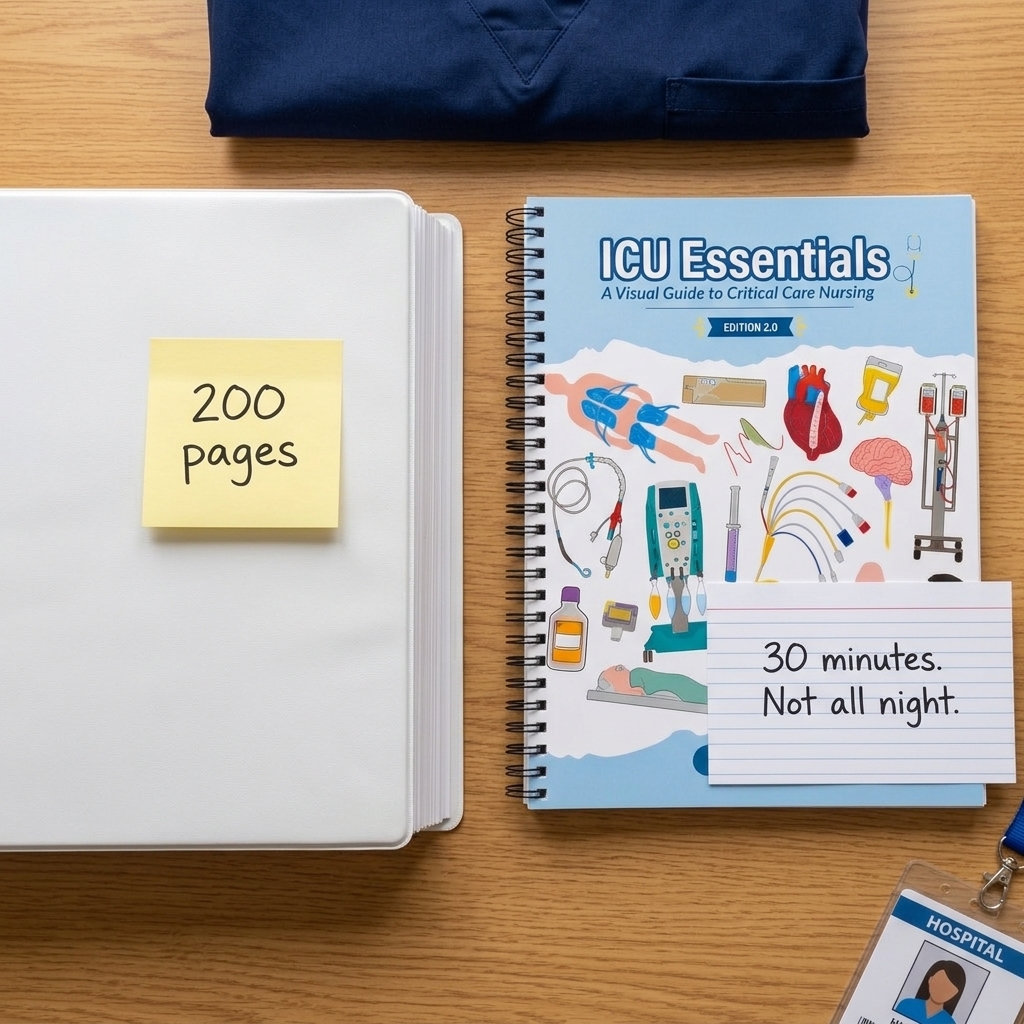
A new grad who walks into orientation without a bedside reference she can open under pressure is betting that the hospital binder will be enough when the preceptor tests her on week one. That bet has a known outcome — 200 pages of dense prose, a blank mind, and a face that goes red in front of the person whose opinion shapes the next 90 days of her career.
ICU Essentials is $39. It covers vasopressor management, ventilator alarms, arterial line troubleshooting, MTP activation, CRRT setup, and 10 tabbed clinical sections organized for 30-second bedside retrieval. One preceptor, nine years in the ICU, wrote: “I’ve been a nurse for nine years and I still open this book on complex cases.”
The 30-minute prep time — not all night, not every night — is the direct product of the scenario-organized format. A new grad spending 30 minutes the night before a shift walking through the relevant tab arrives at a qualitatively different level of readiness than one who spent three hours re-reading a text chapter that will not open on a WOW mid-shift.
At $39, the question is not whether ICU Essentials is worth it. The question is what the first preceptor test costs when a new grad shows up without it.
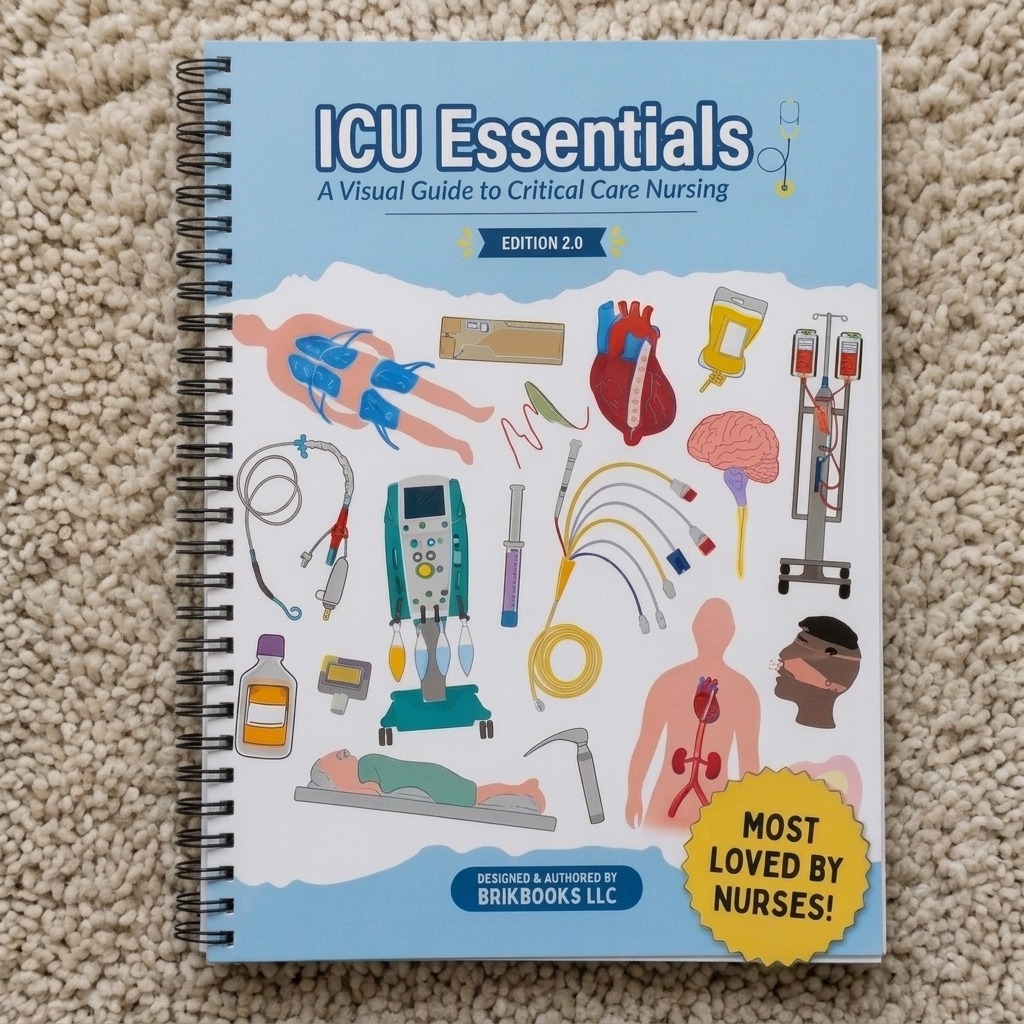
ICU Essentials: A Visual Guide to Critical Care Nursing
10 tabbed clinical sections organized by clinical situation
Frequently Asked Questions
“Three weeks in. My preceptor said something today that she hasn’t said to any of the other new grads in our cohort. I’m not going to write it here because I don’t want to jinx it. But I think you know what it was.”New grad RN, Neuro ICU — week 3 of orientation Try ICU Essentials risk-free for 30 days →
Advertisement. Individual results vary. Testimonials reflect the experiences of actual customers. Results not typical — individual outcomes depend on clinical setting, orientation structure, preceptor relationship, and frequency of use.